7 Helpful Tips to Put Out a Grease Fire
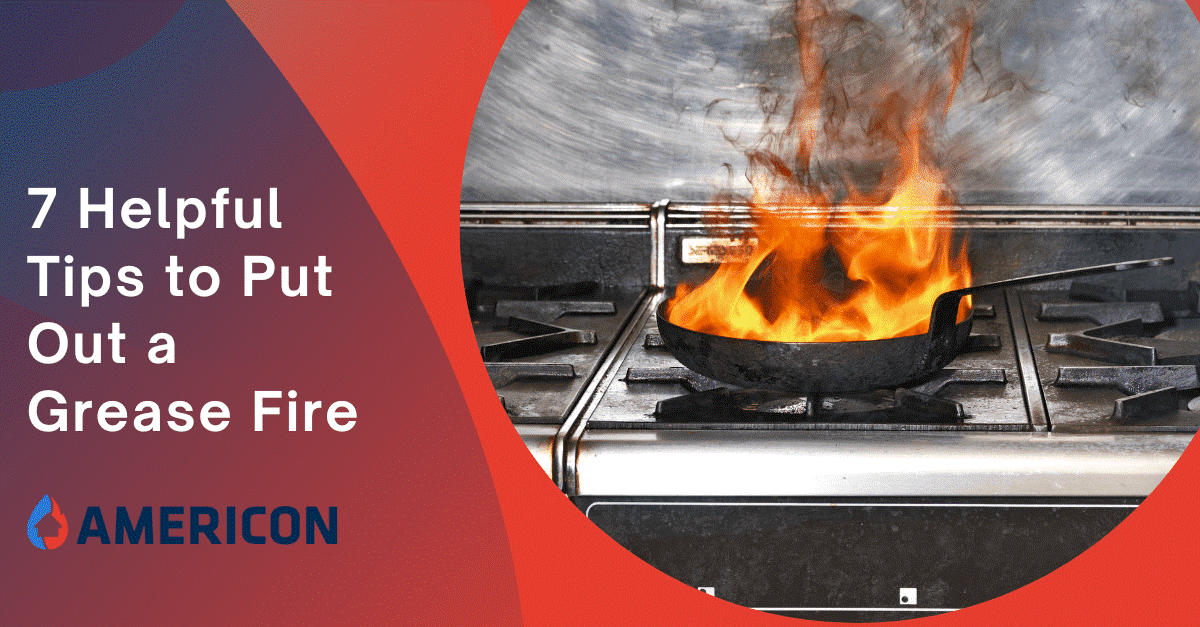
Grease, oil and fat (45%) were reported to be the leading materials that catch fire. A grease fire can cause massive damage and a high number of fatalities if not dealt with properly. Most people don’t know how to put out a grease fire and commit mistakes that can be life-threatening. If you don’t want […]
Grease, oil and fat (45%) were reported to be the leading materials that catch fire. A grease fire can cause massive damage and a high number of fatalities if not dealt with properly.
Most people don’t know how to put out a grease fire and commit mistakes that can be life-threatening. If you don’t want to go through a full-blown fire disaster, read on to master this life-saving skill.
7 Science-Backed Tips on How to Put Out a Grease Fire
Put out a grease fire by smothering the flames with a metal lid or baking soda. Turn off the heat source immediately. Never use water, as it can cause the fire to spread explosively. If the fire grows beyond control, evacuate and call emergency services and then restoration services to ensure minimal damage is caused to the property. Use a Class B fire extinguisher if trained and accessible.
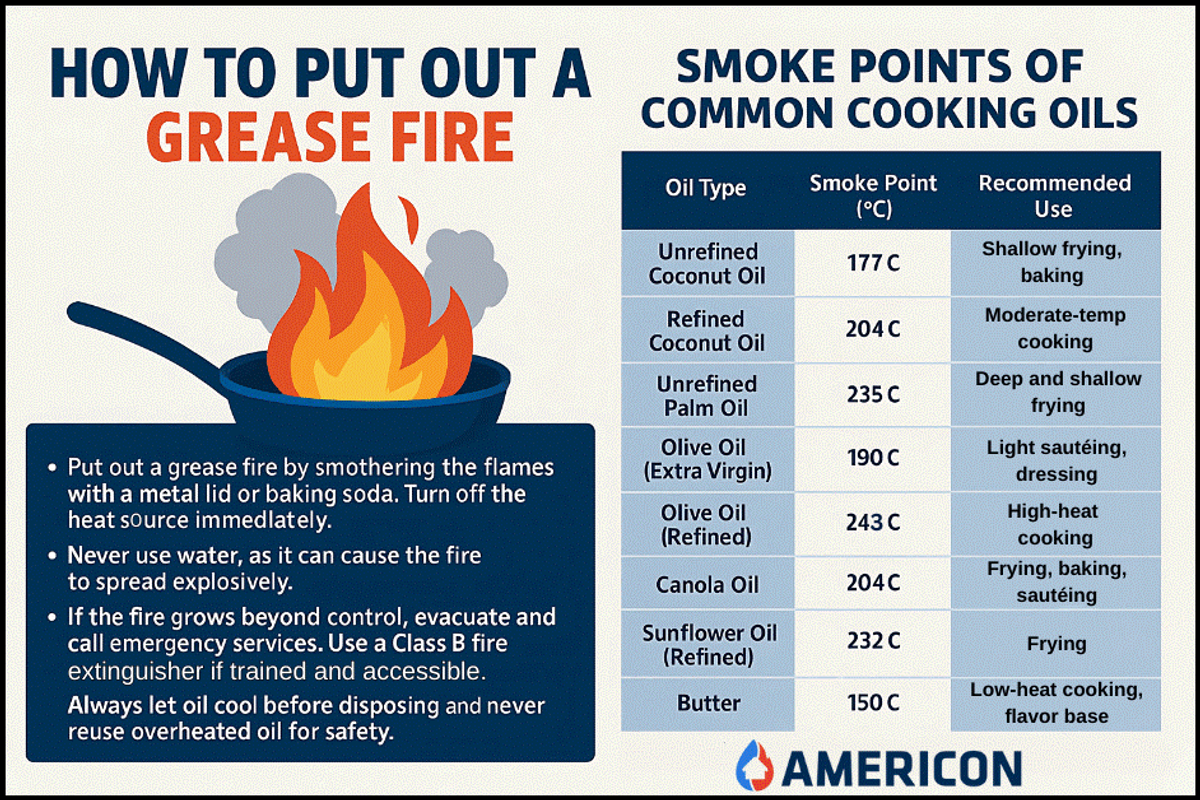
A grease fire is caused by excessively heating an oil above its smoke point. Always let oil cool before disposing and never reuse overheated oil for safety.
Smoke Points of Common Cooking Oils
Oil Type
Smoke Point (°C)
Recommended Use
Unrefined Coconut Oil
177°C
Shallow frying, baking
Refined Coconut Oil
204°C
Moderate-temperature cooking
Unrefined Palm Oil
235°C
Deep and shallow frying
Refined Palm Oil
240°C
High-temperature frying
Olive Oil (Extra Virgin)
190°C
Light sautéing, dressing
Olive Oil (Refined)
243°C
High-heat cooking
Canola Oil
204°C
Frying, baking, sautéing
Sunflower Oil (Refined)
232°C
Frying
Butter
150°C
Low-heat cooking, flavor base
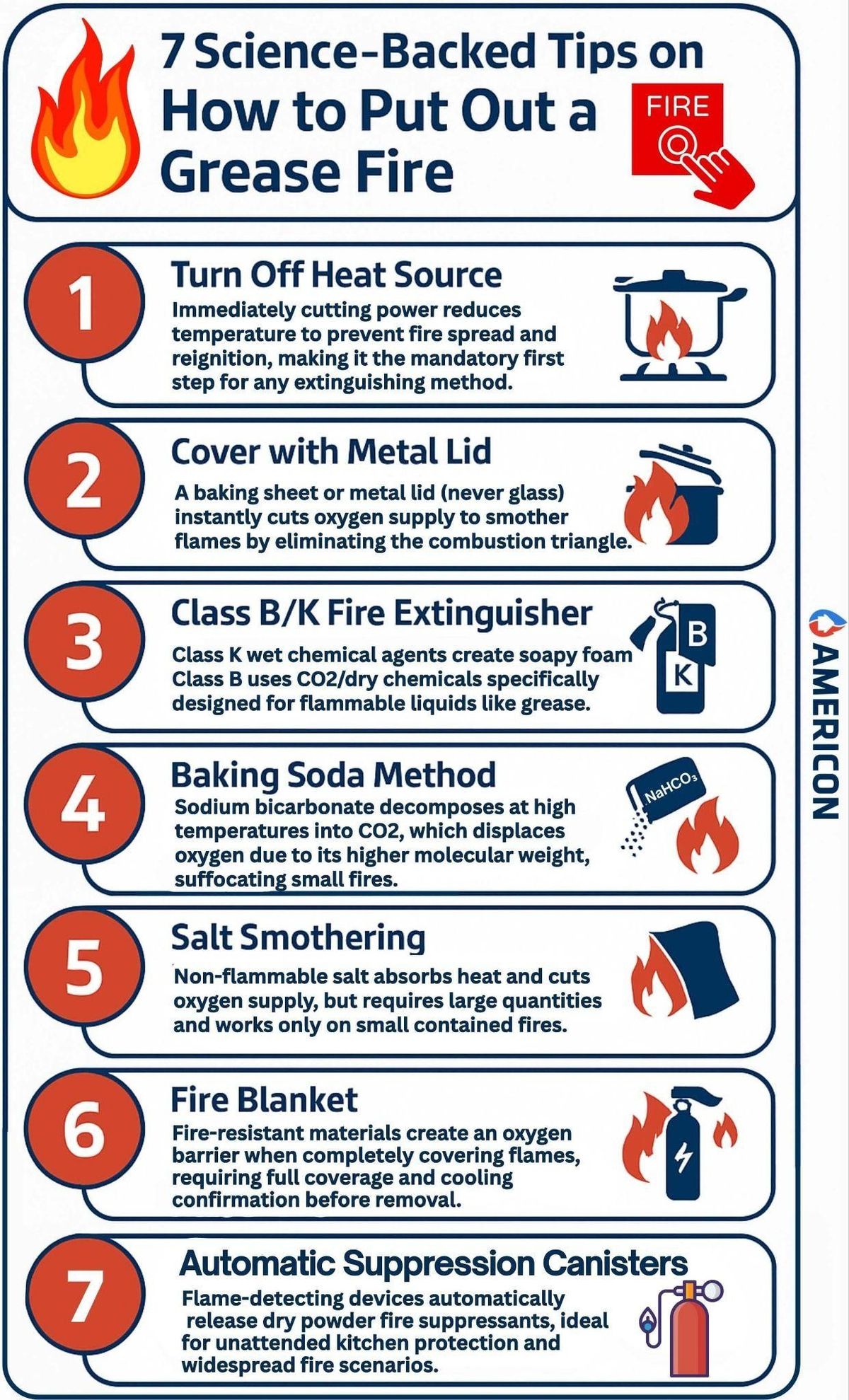
Listed below are 7 techniques that you can use to put out a grease fire:
1. Turn Off the Heat Source
Turning off the heat source immediately will reduce the temperature, preventing the grease fire from spreading or reigniting.
No matter what method you are applying to quench the grease fire, this needs to be the first step.
2. Cover the Flames with a Baking Sheet or Metal Lid
Fire needs oxygen to burn and spread. Once you cover the flames with a baking sheet or metal lid (don’t use a glass lid), it cuts off the oxygen supply and ultimately puts off the fire.
3. Employ a Class B or Class K Fire Extinguisher
Class K fire extinguishers are formulated specifically to tackle grease fires. They employ a wet chemical agent that generates a soapy foam and cuts off the oxygen supply.
In case of unavailability of Class K, you can go for Class B extinguishers designed for flammable liquids such as grease, gasoline and oil. They usually use carbon dioxide (CO2) or dry chemicals to suppress the fire.
4. Douse the Flames with Baking Soda
Baking soda or sodium bicarbonate can extinguish grease fires in the kitchen, particularly small fires. At high temperature (resulting from the heat content of the fire), baking soda decomposes into CO2. CO2, having a high molecular weight, displaces oxygen, sustaining the fire.
5. Smother Flames by Salt
Salt is a non-flammable powder that can douse a grease fire by cutting the oxygen supply and absorbing heat. However, the use of salt is a comparatively less effective methodology suitable only for small contained fires. Moreover, you will need large quantities of salt, which may not be readily available.
6. Fire Blanket
While keeping your body away, put the fire blanket in a way that it completely covers the flame. Inadequate coverage or a small blanket will leave oxygen exposed and the burning process will continue. Don’t remove till the point you are sure enough that the fire has gone out and the area is cool.
Fire blankets are composed of fire-resistant materials that can serve as a barrier between oxygen and fire, curbing the spread of fire and putting it out.
7. Automatic Fire Suppression Canisters
Installing automatic fire suppression canisters is helpful as they are automatically activated when they detect a flame. They release a fire-suppressing material similar to a dry powder on the fire and douse the flame.
In case if the fire has spread over the flammable items in the kitchen and is beyond control, immediately call 911 to seek assistance.
Comparison of Various Grease Fire Suppression Approaches
Methods
How it Works
Effectiveness
Caution/Limitation
Baking Soda
Releases CO2, O2 displacement
Moderate
Large amounts needed
Salt
Covers the fire & cuts off O2 supply
Low to Moderate
Large amounts needed, ineffective for large fires
Metal Lid
Cuts off the O2 supply
High
Ensure the fire area is completely covered
Fire Blanket
Fire-resistant components cut off the O2 supply
Moderate
Can’t be reused generally, Not meant for spreading or large fires, Risk of splashing hot oil in an attempt to cover it
Class K Fire Extinguisher
Saponifies oil, Cooling layer formation
Very High
Careful usage maintaining a proper distance
Why Early Ventilation Can be Dangerous?
Opening the doors and windows immediately after the grease fire is controlled can be dangerous especially if the fire isn’t fully extinguished as it can lead to a flashover. A smoldering fire has the potential to erupt into a full-blaze fire owing to the fresh oxygen (coming from open doors/windows).
Always ventilate slowly starting with one small fan or window. Wide air paths are to be opened for ventilation once you’re sure that no chances of re-ignition exist.
Smoke Management & Fire Damage Clean-Up
Once the fire is 100% out, you are left with the smoke residues & the fire damage that have their own risks and need professional restoration.
Why is Smoke Management Crucial?
Smoke contains certain chemicals that pose multiple health risks necessitating smoke management. For example
- Acrolein (decreases breathing rate, eye irritant)
- Polycyclic Aromatic Hydrocarbons (carcinogenic)
- Particulate Matter (Irritate Lungs, Bronchitis, Asthma Attacks)
Why You Need a Professional Fire-Damage Restoration Services?
You need a professional fire damage restoration services because you can’t deal with the following issues completely and effectively on your own.
- Mold Damage (Because of the water used to extinguish the fire)
- Presence of Acidic Compounds (potential to corrode surfaces, decreases lifespan of affected materials)
- Decreased Property Value (owing to the odor and smoke)
- Structural Integrity (at stake because of the damage caused by the grease fire)
- Deteriorated Air Quality (resulting from the soot and smoke)
- Help with Insurance Claims
You need a professional fire damage restoration services because home cleaning probably isn’t the best option, as it won’t be able to restore the damage. Moreover, it can’t deal with the toxins and odors deeply penetrated into materials.
Best Practices for Prevention of Grease Fire – Advanced Safety Protocols
- Never leave oil unattended on a stove for longer periods
- Clean the oven and stovetop regularly to avoid grease buildup
- Consider smoke alarms
- Automatic fire suppression devices
- Upgrade to induction cooktops
- Use of oils having higher smoke points
- Thermostatically controlled skillet
Are You Seeking Grease Fire Restoration Services?
If you are in search of grease fire restoration services, Americon has a highly trained and fast-acting team of skilled individuals with advanced equipment and safety training. Our professional staff will offer exceptional services to mitigate fire damage, restore your damaged property, and clean your belongings while creating minimal hindrance in your day-to-day routine; we ensure fully hands-off restoration for our clients.
Frequently Asked Questions:
1. Is the use of water safe to put out a grease fire?
Not at all. It will splatter the fire, making it worse than you can imagine.
2. Can I use baking powder or flour to extinguish a grease fire?
No, baking powder and flour aren’t recommended for putting out a grease fire as they are flammable.
3. Is a Class A fire extinguisher effective for a grease fire?
No, a class A fire extinguisher isn’t designed for a grease fire. It uses foam or water, which can cause a flare-up.
4. Can I put out a grease fire with a wet towel?
No, a wet towel can further spread a grease fire owing to its water content.